
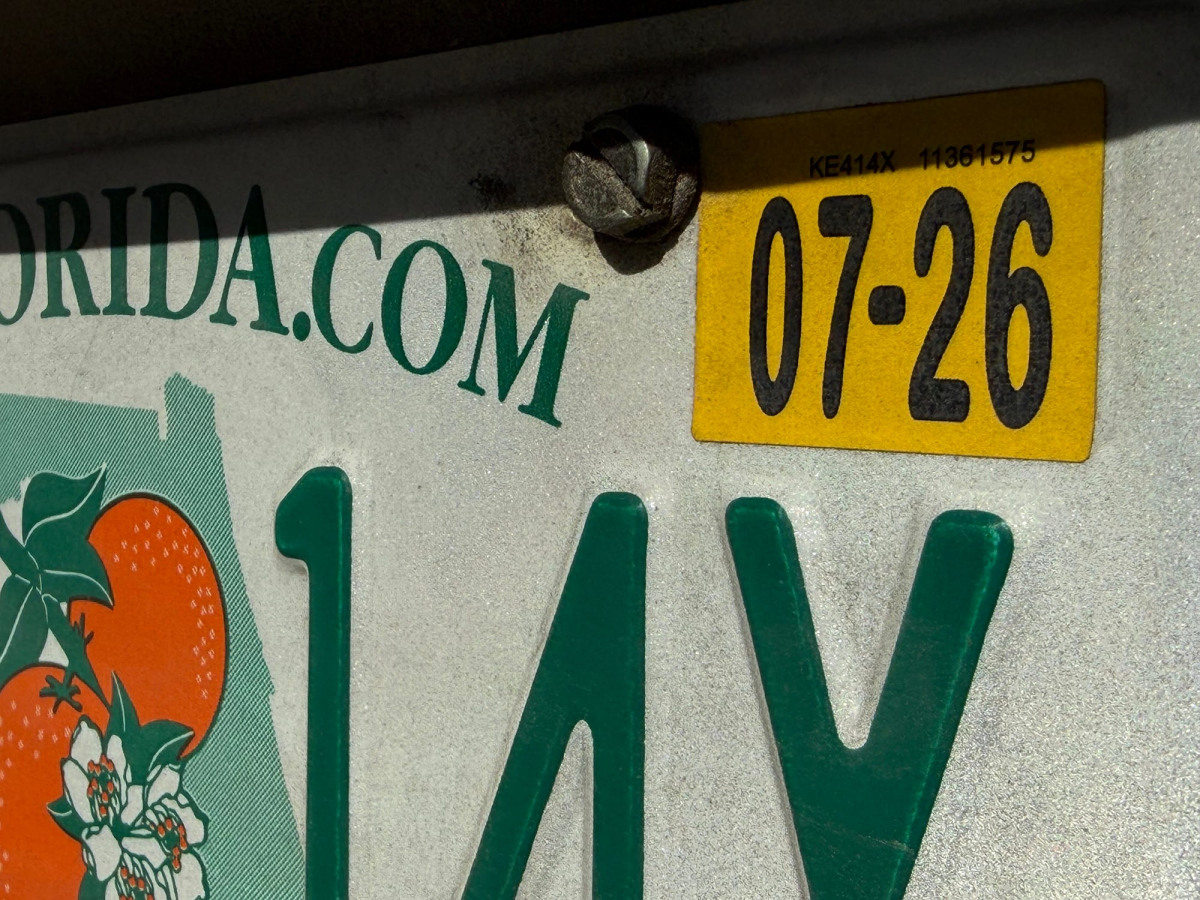
Legislators in Florida have introduced proposals to do away with the small yellow registration decals currently placed on license plates. Governor Ron DeSantis has voiced his approval of this initiative.
"Good job Tom — get it done!" the governor stated on social media on Sunday, December 21.
He was addressing Representative Tom Fabricio, a Republican from Miami Lakes, who is leading House bill HB 841. A corresponding Senate bill, SB 982, was submitted by Senator Ana Maria Rodriguez, a Republican from Homestead.
Fabricio acknowledged that the concept originated from Miami-Dade County Tax Collector Dariel Fernandez.
"I filed HB 841 with @SenatorAMR to eliminate Florida’s outdated yellow registration decals," Fabricio posted online. "They fade, get stolen & cost millions. Let’s cut red tape, fight fraud & save money."
As per Fernandez's recommendation, the legislation would shift registration renewals to an electronic system. All mentions of validation stickers for vehicle registration would be erased from Florida's legal statutes.
Potential Impact of the Proposed Legislation
If enacted, drivers would no longer obtain yellow validation stickers to affix to their license plates. Police officers would check registration status using electronic methods instead.
Will Vehicle Registration Renewal Still Be Necessary?
Yes. The renewal procedure and timelines would remain unchanged, except for the elimination of the sticker.
Fernandez highlighted that discontinuing the decal could lead to "an estimated savings of million dollars each year for residents of Miami-Dade County alone, by reducing production, mailing, and replacement costs," though a detailed analysis was not provided. He also noted that the current system is susceptible to sticker theft and counterfeiting, and the new approach would enhance security.
Other States' Approaches to Registration Stickers
Several states, including New York, Texas, and the District of Columbia, have recently transitioned to windshield or window decals to prevent theft from license plates.
Pennsylvania ceased issuing stickers in 2003. Connecticut adopted windshield stickers in 2006 and eliminated them completely in 2010. New Jersey has not mandated registration stickers since 2004.
Historical Context of Florida's Registration Decals
In Florida, for many years, license renewal involved issuing a new metal plate with raised dates. To cut expenses, the state began using renewal decals starting with the 1976 plate, as reported by the Florida Department of Highway Safety and Motor Vehicles.
For decades, the decals varied in color annually, aiding law enforcement in quickly identifying vehicles with expired registrations. However, by the 2000s, all stickers became yellow with black lettering.
Recent Changes to Florida License Plate Regulations
Floridians are also adjusting to another new license plate law that took effect a few months ago. Since October 1, any item that obstructs a license plate is prohibited in Florida.
The law targets tinted covers and devices designed to hide plates from law enforcement. There was uncertainty about whether it also banned license plate frames, which are commonly used across the state.
After some unclear guidance from various law enforcement agencies, the Florida Department of Highway Safety and Motor Vehicles issued a clarification on Monday, December 15.
According to a memo distributed to all Florida law enforcement agencies and shared on social media, the department requires clear visibility of:
- The alphanumeric plate identifier
- The decal in the top right corner of the license plate
"The Department of Highway Safety and Motor Vehicles does not consider the information on the bottom of the plate to be a primary feature of the plate," the agency explained. "A plate frame that impinges on the information at the top of the plate is permissible, as long as law enforcement is able to identify the state that issued the plate."
Effective Date of the Proposed Law
If approved by the Florida Legislature and signed by Governor DeSantis, the new regulation would become effective on July 1, 2026.

