Partnership Evolution
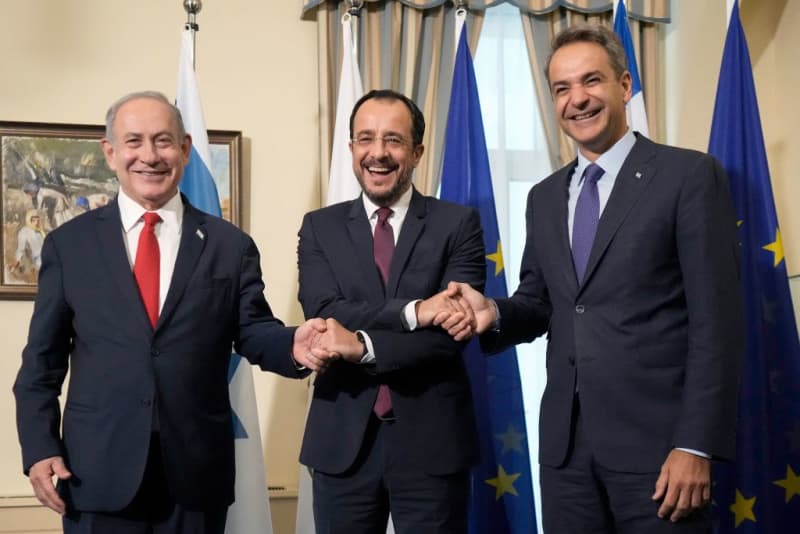
Prime Minister Benjamin Netanyahu is scheduled to meet with Greek and Cypriot leaders in Jerusalem on Monday, continuing a strategic partnership that has transformed significantly over the past decade and a half.
This alliance began approximately 15 years ago following the deterioration of Israel's relationship with Turkey, though it was initially presented as focusing on energy collaboration and diplomatic engagement.
Changing Priorities
What was once subtle has become more direct, with apprehensions regarding Turkey's regional objectives increasingly shaping the partnership's agenda.
Natural gas projects once provided both the framework and justification for strengthening connections with Greece and Cyprus, two nations that had historically been among Israel's most vocal European critics. Infrastructure projects like pipelines and electrical grid connections allowed for enhanced cooperation without explicitly positioning it as opposition to Turkey.
However, as energy initiatives have stalled or transformed and regional tensions have intensified, caution has been replaced by greater openness. Security collaboration, which previously followed discussions about energy, has now become the central element of the relationship.
Historical Context
The partnership's origins trace back to the early 2000s, when Israel's offshore gas discoveries coincided with worsening relations with Ankara following Recep Tayyip Erdogan's election as prime minister in 2002.
As Erdogan fundamentally altered Turkey's stance toward Israel, particularly evident during the 2010 Mavi Marmara incident, Israel lost a key strategic ally. Consequently, Israel sought new regional partners, with Greece and Cyprus emerging as natural alternatives due to their historical rivalries with Turkey and wariness of its regional ambitions.
Energy cooperation initially provided a neutral framework that could serve as a foundation for closer ties, bringing Israel closer to Europe and facilitating coordination with two EU member states without immediately defining the alliance as countering Turkey.
Strategic Shift
The ambitious EastMed pipeline project, which envisioned transporting gas from Israel through Cyprus and Greece to Europe, offered a compelling vision around which this alignment could develop. This cooperation was particularly notable given that Greece and Cyprus had been among Israel's most consistent European critics for decades.
While energy routes were attractive partly because they bypassed Turkey, this rationale was rarely stated explicitly. The emphasis remained on positive aspects like cooperation, development, and regional stability.
Over time, the limitations of this approach became apparent. The EastMed pipeline project ultimately stalled due to high costs, technical challenges, shifting energy markets, and the withdrawal of U.S. support in 2022.
Security Focus
Although energy cooperation hasn't disappeared entirely, with gas exports to Egypt and discussions about undersea electricity cables continuing, gas no longer carries the political weight it once did. Instead, the relationship has been sustained by expanding security cooperation that had been developing alongside energy initiatives.
Even before ambitious gas projects faltered, Israel and Greece were establishing extensive military ties. Israeli pilots trained in Greek airspace after access to Turkish airspace was restricted, joint exercises increased in scope and frequency, and intelligence sharing deepened.
Cyprus similarly strengthened its security dialogue with Israel, even permitting IDF soldiers to train on its territory.
Institutional Development
By the early 2020s, this cooperation had matured into formal institutional arrangements. Long-term defense agreements were signed, major procurement deals advanced, and coordination among air, naval, and ground forces became routine rather than exceptional.
What has changed in recent years isn't the existence of this cooperation but the context in which it's discussed. Turkey's regional actions have heightened threat perceptions across the Eastern Mediterranean.
For Greece, concerns center on potential escalation through miscalculation. For Cyprus, the issue involves the permanence of a divided island supported by substantial Turkish military presence. For Israel, Turkish deployments or influence could potentially complicate operational freedom over neighboring airspace.
Current Dynamics
Recent reports about potential trilateral rapid-response frameworks involving Israeli, Greek, and Cypriot forces have prompted official denials, emphasizing that no standing joint force is being established. These denials reflect both practical constraints and a desire to avoid formal alliance commitments.
However, they also indicate a willingness to signal that the three countries are considering coordinated crisis response mechanisms. A decade ago, such discussions would have remained entirely confidential. Today, even denying them conveys a message.
There's an inherent irony in this evolution. While energy was long portrayed as the foundation of the Israel-Greece-Cyprus partnership, Turkey was the underlying reason for its formation, even if this wasn't explicitly acknowledged initially.
As ambitious energy projects have faded or transformed, the relationship's core elements—security cooperation, defense procurement, intelligence sharing, and close diplomatic coordination—have proven more enduring than any infrastructure plan. Turkey, once a background constant, has become the catalyst clarifying why this alignment matters in today's fluid regional order.