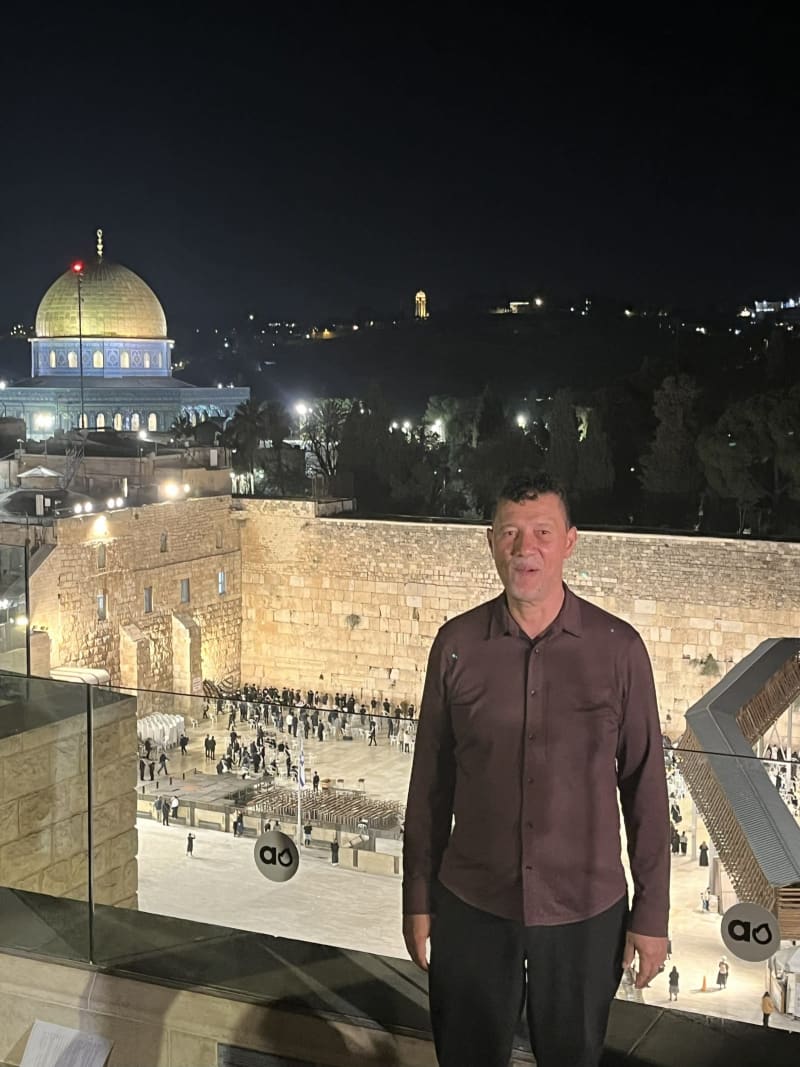
In Jerusalem's Old City last month, an intercultural gathering brought together representatives from different backgrounds. The event was organized by the Aish World Center and Indigenous Bridges, featuring Regent Xami Thomas of South Africa's Khoi Nation as the keynote speaker.
Rabbi Daniel Rowe of Aish began the evening by acknowledging the importance of allies like Regent Xami. "Jewish people are an indigenous nation constantly under attack," he stated. "To have friends who bravely stand with us is a powerful honor. I remember as a child hearing about boycotts against apartheid South Africa. To now see those same accusations weaponized against us is painful, but evenings like this give hope."
Ateret Shmuel, executive director of Indigenous Bridges, emphasized the significance of indigenous solidarity amid rising antisemitism. "One of the main antisemitic narratives today is the lie that Jews are colonial white settlers who dispossessed indigenous peoples. Regent Xami's presence here dismantles that falsehood," she explained.
Shmuel further noted that while the United Nations originally recognized Jews as indigenous, the definition was later changed to exclude Jewish sovereignty. "The UN now defines 'indigenous' as a minority that is oppressed. That standard is deeply problematic," she said. "Regaining stewardship of your ancestral land does not make you any less indigenous."
Personal Experience with Apartheid
Regent Xami, who personally endured South Africa's apartheid system, described accusations against Israel as "deeply offensive and historically inaccurate." He highlighted the growing division between South Africa's ANC government and many citizens who support Israel.
Born in Cape Town and now living in Atlantis, Regent Xami comes from the Khoi people, one of Southern Africa's original tribes. His community faced forced identity changes under colonial rule, being labeled "colored" to erase their connection to the land. "The very term 'colored' was imposed on us to try to remove our identity and our connection to the land which the whites took by force," he recalled.
Before European arrival, the Khoi and San peoples inhabited southern Africa with distinct cultures and spiritual traditions. European colonization brought land seizures, forced labor, and diseases that devastated communities.
Contrasting Realities
Drawing from his firsthand experience, Regent Xami outlined key differences between South African apartheid and Israel's society:
• Legal justice: South African courts upheld white supremacy, while Israel's Supreme Court includes Arab justices who protect minority rights.
• Public spaces: South Africa had segregated beaches and facilities, whereas Israel's are open to all.
• Education: Schools for non-whites in South Africa were deliberately inferior, while Israel has Arab professionals in all fields.
• Transportation: Black South Africans faced bus segregation, unlike Israel's integrated system.
• Military: "That is impossible in a true apartheid state," he noted. "Here in Israel, you have Muslim/Druze officers commanding Jewish soldiers."
He views the misuse of "apartheid" as part of a campaign to delegitimize Israel morally. "They want to break down the moral barrier," he warned. "If they can paint the Jews as evil, then they believe they can justify destroying them."
Addressing South Africa
Regent Xami directly addressed South Africa's leadership, stating: "If you want to know if God is real, look at the Jews. Otherwise, they would have been wiped out centuries ago." He believes Israel's survival demonstrates divine protection.
He criticized South Africa's International Court of Justice case against Israel, noting that most South Africans are Christians who recognize Israel's biblical connections. "The majority of South Africans are Christians," he observed. "They read in the Bible how God gave the land to the Jewish people. They know Israel has a right to defend itself."
Regent Xami called for implementing the UN Declaration on the Rights of Indigenous Peoples regarding both Jewish people and the Khoi community. He expressed concern about South Africa's alliances with anti-Israel groups, warning: "You are taking the side of the losing team. There is real genocide happening in Nigeria and Sudan, yet you accuse Israel, one of the most democratic nations on Earth."
Indigenous Solidarity
Jason Watson of Indigenous Bridges highlighted the hopeful message for Israel. "What stood out was Regent Xami's call to recognize Israel as a rare success story of indigenous decolonization," he said. "He contrasted it with his own tribal nation, where unity and opportunity are far more fragile, and urged Jewish attendees to treasure the strength they have here."
Participant Rudy Rothman found inspiration in applying Jewish values to global issues. "We happened to be one of the only peoples to receive liberation at this level. We are clearly a success model for indigenous people around the world, especially those suffering due to colonialism," he remarked.
Rothman added that Israel's achievements, like reviving Hebrew, offer hope to other indigenous communities. "Israel, as a liberated country, has a responsibility to help indigenous communities to achieve their own freedom," he concluded.