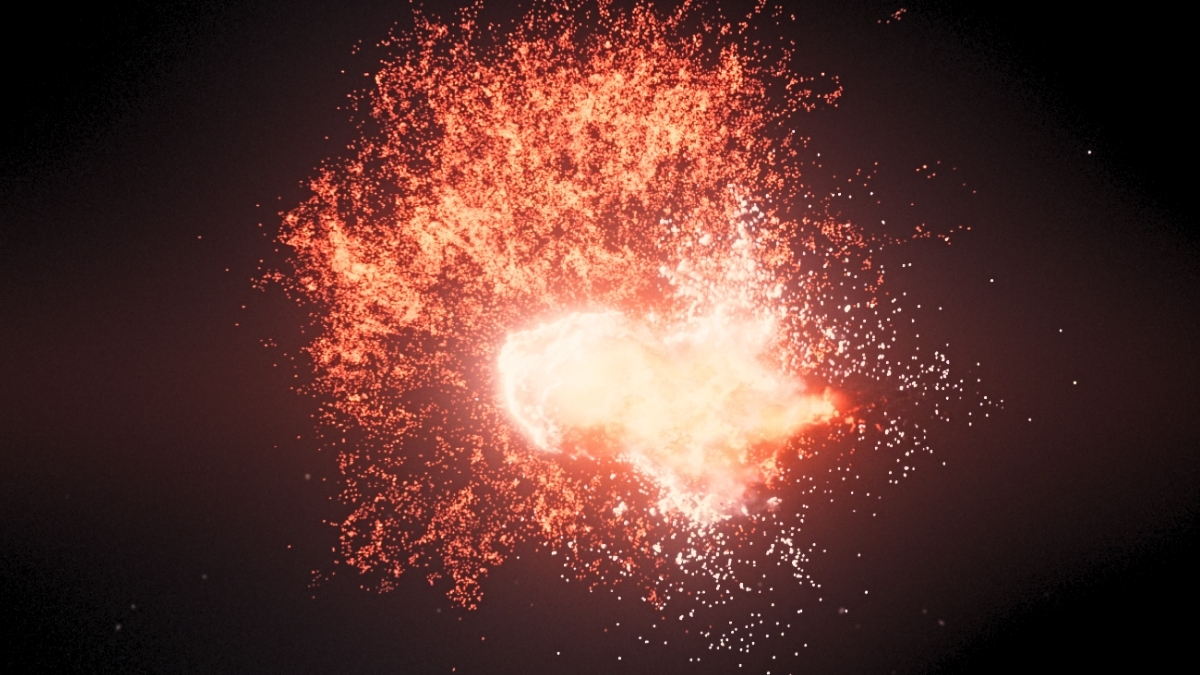
For just the second time in recorded history, astronomers have detected a violent impact between two asteroids within a planetary system beyond our own. This remarkable event occurred around the star Fomalhaut, located a mere 25 light-years from Earth.
Fomalhaut, a relatively young star at 440 million years old, remains encircled by a debris disk from its formation period. This makes it an ideal cosmic laboratory for studying the early stages of planet development.
"This is certainly the first time I've ever seen a point of light appear out of nowhere in an exoplanetary system," says astronomer Paul Kalas of the University of California, Berkeley. "It's absent in all of our previous Hubble images, which means that we just witnessed a violent collision between two massive objects and a huge debris cloud, unlike anything in our own Solar System today. Amazing!"
The newly observed collision follows a similar event detected in 2004, when astronomers initially believed they had discovered a planet they named Dagon. Subsequent observations revealed Dagon was actually a dust cloud from an asteroid impact, now designated Fomalhaut cs1.
"With these observations, our original intention was to monitor Fomalhaut b, which we initially thought was a planet," says astronomer Jason Wang of Northwestern University. "We assumed the bright light was Fomalhaut b because that's the known source in the system. But, upon carefully comparing our new images to past images, we realized it could not be the same source. That was both exciting and caused us to scratch our heads."
The latest collision has been named Fomalhaut cs2, with both events involving rocky bodies approximately 60 kilometers in diameter. Researchers estimate about 300 million similar objects orbit within the Fomalhaut system.
"Previous theory suggested that there should be one collision every 100,000 years, or longer. Here, in 20 years, we've seen two," Kalas notes. "If you had a movie of the last 3,000 years, and it was sped up so that every year was a fraction of a second, imagine how many flashes you'd see over that time. Fomalhaut's planetary system would be sparkling with these collisions."
Astronomer Mark Wyatt of the University of Cambridge explains the significance: "The exciting aspect of this observation is that it allows researchers to estimate both the size of the colliding bodies and how many of them there are in the disk, information which is almost impossible to get by any other means."
Additional observations from the James Webb Space Telescope in 2023 revealed another dust concentration in the same region, potentially indicating yet another collision event awaiting confirmation.
"Fomalhaut cs2 looks exactly like an extrasolar planet reflecting starlight," Kalas explains. "What we learned from studying cs1 is that a large dust cloud can masquerade as a planet for many years. This is a cautionary note for future missions that aim to detect extrasolar planets in reflected light."
Researchers plan continued monitoring of cs2 using both Hubble and JWST to track its evolution. "We will be tracing cs2 for any changes in its shape, brightness, and orbit over time," Kalas says. "It's possible that cs2 will start becoming more oval or cometary in shape as the dust grains are pushed outward by the pressure of starlight."
Wyatt concludes: "The system is a natural laboratory to probe how planetesimals behave when undergoing collisions, which in turn tells us about what they are made of and how they formed."