
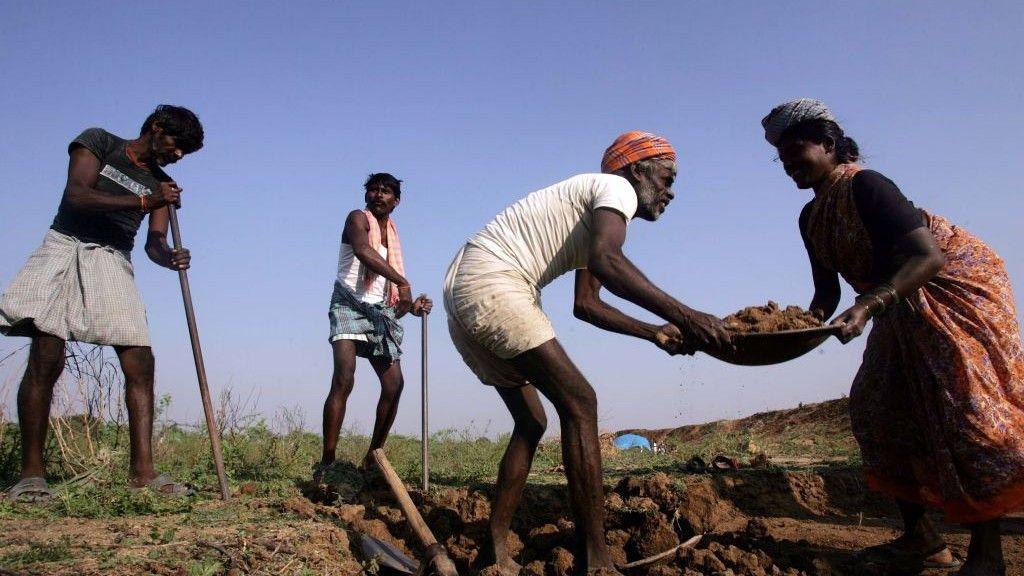
India's Rural Employment Initiative Transformed
India operates one of the globe's most extensive social welfare initiatives - a rural employment guarantee that provides legal entitlement to paid labor for households in countryside regions.
Introduced in 2005 under a Congress-led administration, the National Rural Employment Guarantee Scheme (NREGS) established a statutory right for rural families to request up to 100 days of manual employment annually at government-set minimum wages.
This program holds particular significance in a nation where approximately 65% of its 1.4 billion residents inhabit rural territories, with nearly half dependent on agricultural activities that contribute merely 16% to national economic output.
Program Evolution and Impact
By offering unskilled public employment across predominantly rural districts, the initiative has become fundamental to rural economic stability, buffering against economic downturns. It represents one of the planet's most extensively researched poverty alleviation efforts, demonstrating notable equity: more than 50% of the estimated 126 million participants are female, while about 40% belong to historically marginalized caste or tribal communities.
The current administration, initially skeptical and later seeking to reduce the program's scope, increasingly relied on it during emergencies - most prominently throughout the Covid-19 pandemic when massive reverse migration from urban centers to villages dramatically increased work demand. Economic analysts indicate the scheme boosted rural spending, decreased poverty levels, enhanced school participation, and elevated private-sector wages in certain areas.
Legislative Changes and Controversy
Recently, authorities enacted fresh legislation that replaces and renames the initiative. Originally rebranded MGNREGA in 2009 to honor Mahatma Gandhi, the program has now completely removed his name from its title.
While the name alteration attracted political attention, more substantial modifications reside in the new law's actual provisions - commonly abbreviated as G RAM G.
The revised legislation increases the annual employment guarantee from 100 to 125 days per rural household. It maintains the requirement that workers denied employment within 15 days receive unemployment compensation.
Under the previous framework, the central government covered all labor wages and most material expenses - approximately a 90:10 division with state governments.
Financing will now follow a 60:40 distribution between federal authorities and most states. This adjustment could elevate states' contributions to 40% or more of total project expenses. The central government retains oversight, including authority to announce the program and determine state-specific allocations.
States maintain legal responsibility for providing jobs - or distributing unemployment benefits, even as the federal government designates $9.5 billion for the program in the current fiscal year concluding next March.
Government Perspective and Criticism
Officials present the reforms as a modernized, more efficient, and corruption-resistant program designed to empower economically disadvantaged populations.
"This law stands firmly in favour of the poor, in support of progress, and in complete guarantee of employment for the workers," says federal agriculture minister Shivraj Singh Chouhan.
Opponents - including rival political parties, academics, and certain state governments - caution that limiting funds and transferring costs to states might weaken a rare legal entitlement within India's welfare framework.
"It is the culmination of the long-standing drive for centralisation of the scheme under the Modi government. But it is more than centralisation. It is the reduction of employment guarantee to a discretionary scheme. A clause allows the federal government to decide where and when the scheme applies," Jean Dreze, a development economist, told me.
Professor Dreze contends that increasing guaranteed workdays to 125 per household might appear substantial but represents a "red herring." A recent advocacy group report discovered that only 7% of rural households received the 100 workdays guaranteed under the program during 2023-24.
"When the ceiling is not binding, how does it help to raise it? Raising wage rates, again, is a much better way of expanding benefits. Second, raising the ceiling is a cosmetic measure when financial restrictions pull the other way," Prof Dreze notes.
International Concerns and Program Effectiveness
These and other apprehensions seem to have motivated international scholars to petition the current government defending the original program, warning that the new funding approach could compromise its objectives.
"The [scheme] has captured the world's attention with its demonstrated achievements and innovative design. To dismantle it now would be a historic error," an open letter, led by Olivier De Schutter, UN special rapporteur on extreme poverty and human rights, warned.
Certainly, the initiative has confronted persistent difficulties, including inadequate funding and delayed wage payments. For instance, West Bengal's program has experienced severe reductions and funding suspensions since 2022, with federal authorities withholding funds over alleged compliance issues.
Nevertheless, despite these challenges, the program appears to have generated measurable effects.
A significant study by economists Karthik Muralidharan, Paul Niehaus, and Sandip Sukhtankar determined that the scheme's broader economic impacts increased beneficiary households' earnings by 14% and reduced poverty by 26%. The research found workers demanded higher wages, land returns declined, and employment gains were greater in villages.
Structural Challenges and Future Outlook
However, many observers note the program's endurance highlights a deeper structural issue: India's persistent failure to generate sufficient non-agricultural employment to absorb surplus rural labor.
Agriculture has consistently trailed the broader economy, expanding just 3% yearly since 2001–02, compared with 7% for other economic sectors.
Critics like Nitin Pai of the Takshashila Institution think-tank argue the program alleviates hardship but does little to enhance long-term rural productivity, potentially even diminishing incentives for agricultural reform.
"With [the scheme] we're merely treating a serious underlying malaise with steroids," said Mr Pai in a post on X.
The government's Economic Survey 2023–24 questions whether program demand accurately reflects rural distress.
If this were true, data should demonstrate greater fund utilization and employment in poorer states with higher joblessness, the survey states.
Yet it observes that Tamil Nadu, with under 1% of the nation's impoverished population, received nearly 15% of program funds, while Kerala, containing just 0.1% of the poor, accounted for almost 4% of federal allocations.
The survey adds that actual work generated depends substantially on state administrative capacity: states with trained personnel can process requests promptly, directly affecting employment provision levels.
Despite these irregularities, the program's rationale remains compelling in a country where numerous individuals rely on low-income rural work and where the fundamental challenge involves insufficient quality employment.
Even prominent statistics about rising labor participation in India can be deceptive: more people "working" doesn't necessarily indicate better or more productive jobs.
A recent paper by economists Maitreesh Ghatak, Mrinalini Jha and Jitendra Singh finds the country's recent labor force participation increase, particularly among women, reflects economic hardship rather than growth-driven job generation.
The authors state the expansion concentrates in most vulnerable work forms: unpaid family helpers and self-employed workers, who exhibit very low productivity and declining real earnings.
"The recent expansion in employment reflects economic distress leading to subsistence work, rather than growth-driven better quality job creation," they say.
Evidence suggests people enter subsistence work from necessity, not attracted to higher-quality employment by a robust economy.
This ensures the planet's largest employment guarantee program will continue central to hundreds of millions of Indians' livelihoods - whether the revised version will enhance or diminish its impact awaits determination.