
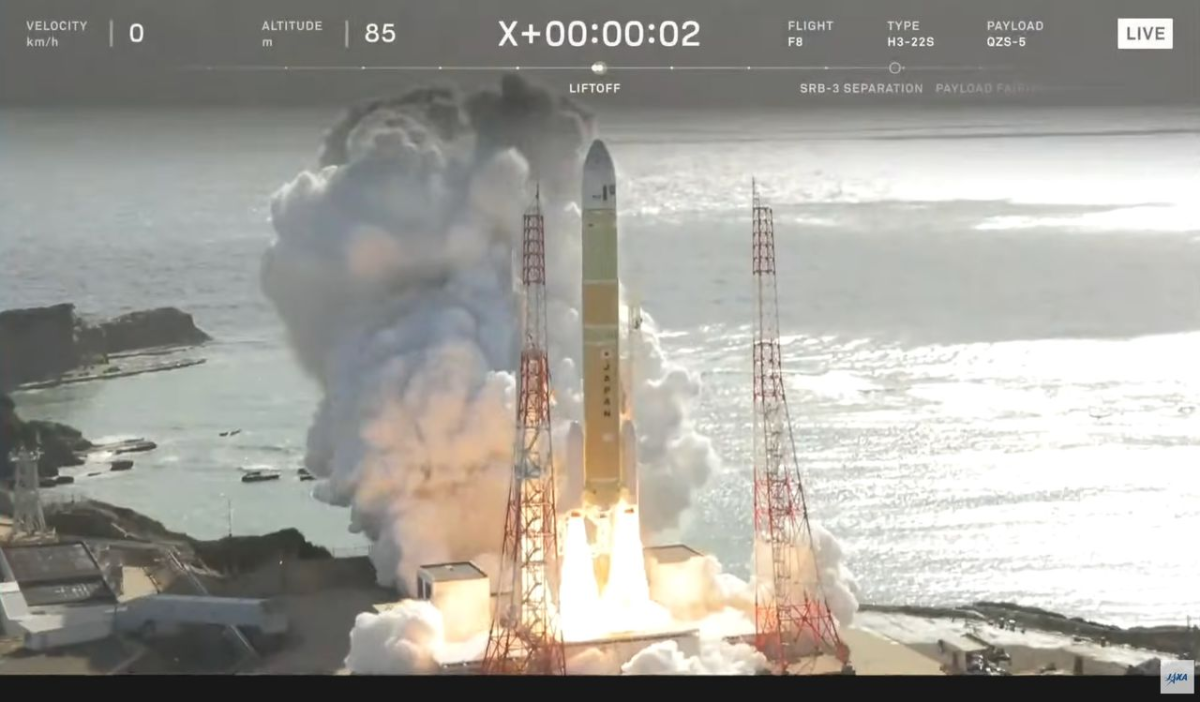
Japan's space program encountered a significant setback during the latest launch attempt of its H3 rocket.
The vehicle lifted off from Tanegashima Space Center at 8:51 p.m. EST on December 21 (0151 GMT on December 22), carrying the Michibiki 5 navigation satellite, also designated QZS-5.
"However, the second stage engine’s second ignition failed to start normally and shut down prematurely," Japan Aerospace Exploration Agency (JAXA) representatives stated in an announcement early Monday morning (December 22). "As a result, QZS-5 could not be put into the planned orbit, and the launch failed."
This satellite, weighing 10,580 pounds (4,800 kilograms), was intended to join Japan's indigenous Quasi-Zenith Satellite System (QZSS), a regional navigation network operating in geosynchronous orbit.
"This system is compatible with GPS satellites and can be utilized with them in an integrated fashion," Japanese authorities noted in documentation about the QZSS initiative.
"QZSW can be used even in the Asia-Oceania regions with longitudes close to Japan, so its usage will be expanded to other countries in these regions as well," they further explained.
The QZSS constellation began with a demonstration satellite launched in September 2010 and currently operates with four spacecraft. Japan has ambitions to expand this network to eventually include 11 satellites, though Sunday's unsuccessful mission represents a temporary obstacle.
The H3 rocket, developed through collaboration between JAXA and Mitsubishi Heavy Industries, serves as the replacement for the retired H-2A launch vehicle, which concluded its service in June after approximately 25 years of operations.
Following an initial failure during its maiden flight in March 2023, the H3 had achieved five consecutive successful missions prior to this latest incident. JAXA has established an investigation team led by agency head Hiroshi Yamakawa to determine the cause of the Michibiki 5 launch anomaly.
"We would like to express our deepest apology to many people and entities, particularly those related to the QZS-5, local organizations and the public, who had high expectations for this project," JAXA officials conveyed in their Monday morning update.