Ocean surfaces are far from level, with winds and gravity creating variations that include powerful warm-water currents flowing toward polar regions. These western boundary currents, including Japan's Kuroshio, have recently shown significant behavioral changes with wide-ranging consequences.
Currents in Motion
Recent observations reveal the Kuroshio Extension has shifted dramatically northward, reaching unprecedented latitudes near Japan's coast. This movement has brought exceptionally warm waters to regions historically dominated by cooler currents.
"I was so surprised I don't even know if 'surprised' is the right word," said Shusaku Sugimoto, an associate professor at Tohoku University in Sendai, Japan.
Sugimoto's research documented temperature increases of 6 degrees Celsius along the Sanriku coast, with elevated temperatures persisting for two years. "This represents a level of water temperature rise we've never seen before," he noted.
Simultaneously, the Kuroshio south of Japan entered an extended "large meander" pattern beginning in August 2017, diverting warm waters away from coastal areas. This pattern recently concluded after nearly eight years, marking the longest such event on record.
Connected Phenomena
Bo Qiu, a Kuroshio expert at the University of Hawaiʻi at Mānoa, explained these changes are interconnected. "It's hard to predict the future, but given the data we have so far, I can only see the intensity becoming larger and larger," he stated.
Qiu co-authored research describing this configuration as a "new dynamic regime" affecting the current system. The Kuroshio transports over 200 times more water than the Amazon River, making its movements particularly impactful.
These shifts have altered sea levels along Japan's coast, with some areas experiencing rises up to half a foot while others saw declines. The Japan Meteorological Agency reported that elevated sea levels during Typhoon Lan in October 2017 amplified coastal damage.
Climate Connections
Scientists are investigating how climate change influences these oceanographic events. The expansion of tropical atmospheric circulation patterns appears to be shifting wind systems that drive currents like the Kuroshio.
"This expansion shifts not just rainfall patterns but also the zones of sinking air that anchor high-pressure systems, such as the Pacific High," explained Brown University climate scientist Emanuele Di Lorenzo.
Between 1993 and 2021, the Kuroshio Extension's northern edge moved approximately 130 miles northward due to wind pattern changes. More extreme shifts occurred in 2023 and 2024, bringing the current near Honshu's northern tip.
Measurements during this period revealed waters up to 18 degrees Fahrenheit warmer than usual, extending 1,300 feet deep. Marine heatwave conditions persisted nearly continuously for over a year, affecting both ocean and land environments.
Ecological and Cultural Impacts
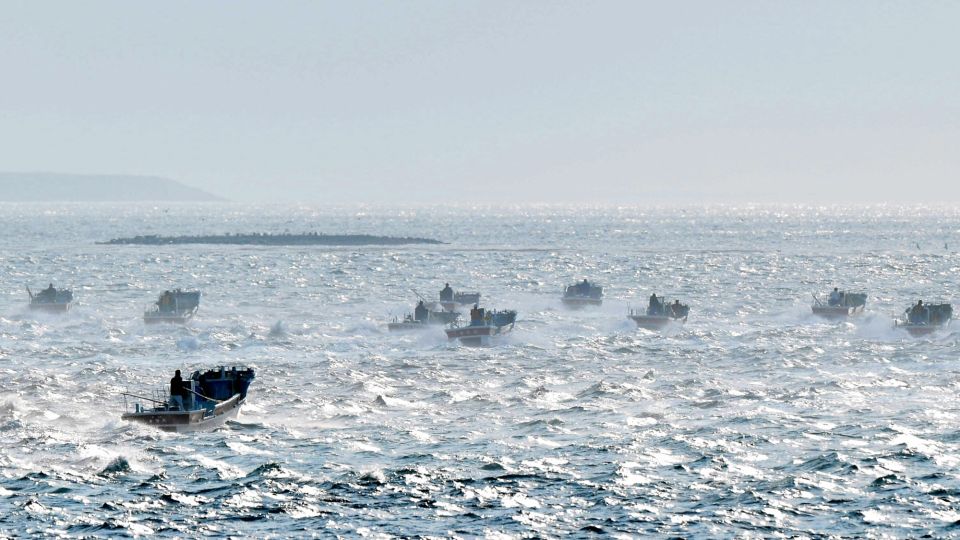
Japan's fisheries have experienced significant disruptions from these current changes. Mackerel catches in central Japan have declined to 20-30% of historical levels, with no immediate recovery expected despite the meander's conclusion.
"Immediate recovery is not a reality, and while conditions may gradually improve, at present, there has been no recovery in catches," said Osamu Nagai of the Mie Gaiwan Fisheries Cooperative Association.
In northeastern Japan, the warm Kuroshio Extension displaced the cool Oyashio current, affecting species including Pacific salmon and saury. The changes extend beyond fish to foundational elements of Japanese cuisine.
"Kombu stocks are declining dramatically. Dashi culture might collapse," said Yoshihiro Tachibana, a climate dynamics professor at Mie University. "This has a tremendous impact on our food culture."
Looking Forward
While the Kuroshio Extension has recently retreated slightly from its extreme northern position, scientists continue monitoring these changes as potential indicators of future ocean conditions.
"It's a great opportunity to learn what the oceans will be like 100 years from now," Sugimoto observed. "Understanding how this has altered the seas of Tohoku offers a chance to understand how the world's oceans will change in the future."
Researchers emphasize that similar changes are occurring in other western boundary currents worldwide, suggesting broader implications for global ocean systems as climate patterns evolve.