Recent months have seen two separate public investigations in South Africa examining long-standing suspicions about corruption and political influence within law enforcement agencies.
President Cyril Ramaphosa is currently reviewing an interim report from a commission he established to probe illegal activities within the police service.
This commission was formed following July allegations by senior police officer Lt-Gen Nhlanhla Mkhwanazi that organized criminal networks had infiltrated government structures.
Lt-Gen Mkhwanazi, who leads police operations in KwaZulu-Natal province, claimed Police Minister Senzo Mchunu had connections to crime figures and had consequently shut down a specialized unit investigating political killings.
Mchunu, a prominent member of Ramaphosa's African National Congress and presidential ally, has rejected all allegations of misconduct.
To investigate these claims, Ramaphosa appointed retired Constitutional Court judge Mbuyiseli Madlanga to lead a public inquiry, while Parliament established its own panel to examine the matter.
"As I see it now, this is terrorism," Gen Mkhwanazi stated during his September testimony as the Madlanga Commission's first witness, adding these were "people who want to take over government, not through the ballot paper but through these criminal activities."
Over three months of testimony, both inquiries have heard about an alleged drug cartel with political connections and a businessman facing attempted murder charges who reportedly has ties to senior government officials.
Allegations of Criminal Networks
Police crime intelligence head Lt-Gen Dumisani Khumalo testified before the Madlanga Commission about a drug trafficking organization operating across multiple provinces that had "penetrated the political sphere."
He identified this group as the "Big Five" cartel and named controversial businessman Vusimusi "Cat" Matlala as one of its alleged leaders.
Mr. Matlala currently faces 25 criminal charges, including attempted murder stemming from incidents between 2022 and 2024, all of which he denies.
Lt-Gen Khumalo alleged the cartel operated both domestically and internationally, primarily dealing in narcotics while also conducting contract killings, cross-border hijackings, and kidnappings.
He claimed the organization had infiltrated the criminal justice system, enabling them to "manipulate investigations, suppress evidence [and] obstruct legal proceedings that threaten their activities."
The crime intelligence boss further alleged this group was responsible for dismantling the political killings task team, believing incorrectly that the unit was investigating them.
Another witness, identified only as "witness C," testified that the Big Five cartel exercised "full control and oversight" across government departments.
Businessman's Alleged Political Connections
Central to allegations against the suspended police minister is his purported relationship with businessman "Cat" Matlala.
At the Madlanga Commission, Mkhwanazi repeated July claims that Mchunu indirectly received financial support from Matlala for political activities, presenting text messages and payment records as evidence.
During his testimony, Mchunu countered: "I have never been accused of corruption, not once. This is the first time I get accused of such."
Mr. Matlala previously held a police contract that was terminated when he was charged with attempted murder in May.
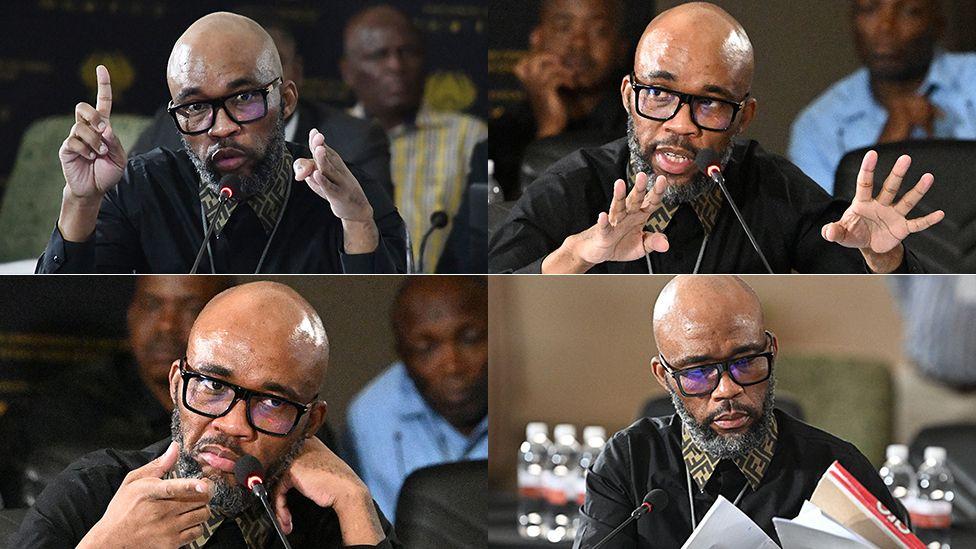
Testifying before Parliament's inquiry while in custody, Matlala described relationships with former and current ministers and senior police officials.
He denied personal acquaintance with senior officers and politicians but acknowledged making payments for ANC-related activities, stating: "From what I understand, the minister [Mchunu] sent [a third party] to go ask for donations there and there, and I was one of them."
Matlala also alleged former Police Minister Bheki Cele demanded a "facilitation fee" of 1 million rand after authorities returned seized firearms, claiming Cele requested the payment to prevent police harassment.
Cele, who testified before Matlala's appearance, admitted knowing the businessman for several months and staying at his penthouse twice as "freebies" but denied receiving any money.
Witness C told the Madlanga Commission that Matlala contributed to the suspended minister's presidential ambitions within the ANC despite doubting his electoral prospects.
Witness Murdered After Testimony
A Madlanga Commission witness identified as "Witness D" was murdered in early December, three weeks after testifying, though any connection between the events remains unclear.
Marius van der Merwe, a former police officer running a private security company, was killed in front of his family as he waited for his gate to open.
During his testimony, Van der Merwe implicated officials including Brig Julius Mkhwanazi, alleging the brigadier ordered him to dispose of a robbery suspect's body after police torture and killing.
Commenting on this, Mr. Van der Merwe told the commission: "I really did not have a chance to agree. I felt like I was being forced."
Brig Mkhwanazi denied involvement, telling the commission he visited a crime scene briefly for "two to three minutes."
Authorities confirmed Van der Merwe had declined witness protection after testifying, and his murder has sparked national outrage about whistleblower safety in South Africa.
Current Status of Investigations
President Ramaphosa's spokesperson Vincent Magwenya stated Judge Madlanga's interim report won't be made public as it's not "helpful to start... debating on something that is half-baked," though the final report expected next year will be publicly released.
The Madlanga Commission operates in three phases: witness allegations, responses from implicated individuals, and witness recall for clarification.
Originally given six months to complete its work, the commission's timeline can be extended as determined by the president, while Parliament's inquiry is expected to resume hearings in 2026.
South Africans await findings from both investigations, questioning whether recommendations will compel government action against problems critics identify within police services.