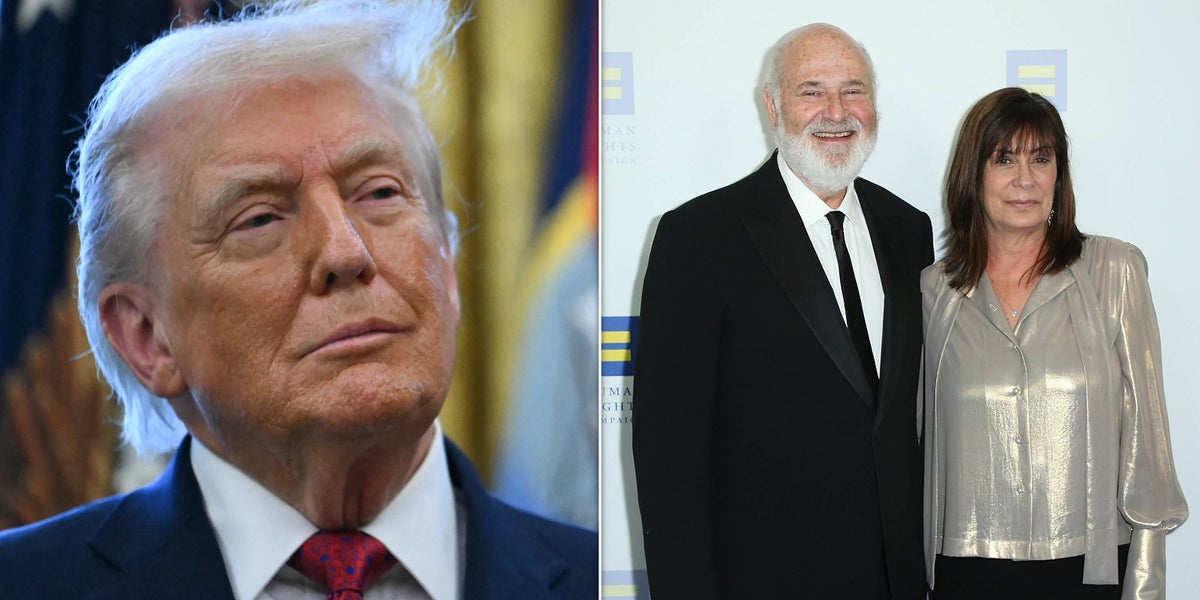
Following the passing of Rob and Michele Reiner, many online platforms were filled with expressions of sympathy and condolences for the bereaved family.
However, a different perspective emerged on Truth Social, where former President Donald Trump shared his thoughts on Monday night.
"A very sad thing happened last night in Hollywood. Rob Reiner, a tortured and struggling, but once very talented movie director and comedy star, has passed away, together with his wife, Michele, reportedly due to the anger he caused others through his massive, unyielding, and incurable affliction with a mind crippling disease known as TRUMP DERANGEMENT SYNDROME, sometimes referred to as TDS," Trump wrote.
"He was known to have driven people CRAZY by his raging obsession of President Donald J. Trump," he continued, "with his obvious paranoia reaching new heights as the Trump Administration surpassed all goals and expectations of greatness, and with the Golden Age of America upon us, perhaps like never before. May Rob and Michele rest in peace!"
This statement was met with disapproval from various quarters, including some of Trump's own supporters who described it as inappropriate and insensitive during a time of mourning.
To understand the psychological factors at play, experts were consulted about why individuals might condemn certain behaviors initially but appear indifferent later.
Psychological Perspectives on the Response
"It is no real surprise that Trump made it all about himself," John Jost, co-director of the Center for Social and Political Behavior at New York University, remarked. "That is what destructive narcissists do, people who exhibit what psychologists refer to as malevolent personality traits."
"Trump also makes Freud relevant again," Jost added. "Projection is an everyday occurrence. In this case, someone is deranged, but it's not Rob Reiner."
Daniel R. Stalder, a social psychologist at the University of Wisconsin-Whitewater, noted that people often seek explanations in the wake of tragedy, even with limited information. He suggested that Trump's post reflects elements of victim blaming.
"In general, unfortunately, it's relatively common to respond to tragedy by searching for and finding some reason to blame the victim(s) of the tragedy," Stalder said. "There are psychological benefits to victim blaming — not that those benefits can excuse it."
Psychotherapist Gina Simmons Schneider highlighted the role of online communication in facilitating dehumanization. "We also know that the more distant we feel from others, the easier it is to inflict harm. That's why we see so much cruelty online," she explained.
Group Dynamics and Polarization
Jay Van Bavel, director of the Center for Conflict & Cooperation at New York University, observed that such reactions have become more pronounced with increasing political polarization.
"Every time this happens, it gets worse," Van Bavel said. "It seems to always reach a new low, if you track polarization in the U.S."
He pointed out that social media algorithms and growing distrust contribute to this trend, with individuals showing greater empathy toward their own groups while displaying less for others.
"Part of it is empathy," Van Bavel noted. "There's greater empathy for members of our own group when they suffer something bad."
Impact of Leadership Behavior
Jost emphasized that the Republican Party under Trump has adopted a more extreme stance, which influences public discourse. "When that is the case, hypocrisy and dishonesty is not a problem for one's constituents, and democratic accountability to the people as a whole (much less the loyal opposition) is non-existent," he stated.
Van Bavel explained that when leaders engage in such behavior, it can encourage followers to do the same. "People who follow politics closely tend to mirror the policies, positions and statements of their leaders — and Trump has an enormous influence over the core people who follow him," he said.
Simmons Schneider referenced historical studies on obedience, noting that authority figures can persuade individuals to act harmfully. "Human history and psychological research have shown that ordinary good people can be made to commit unspeakable crimes by corrupt leaders," she said.
Navigating Social Divisions
In addressing how to coexist despite differences, Simmons Schneider reported an increase in anxiety related to political conflicts within families. "People struggle with the cruelty of our politics while trying to reconcile a vision of themselves as good-natured," she observed.
Van Bavel recommended focusing on shared values and recognizing that extreme voices do not represent the majority. "The most incendiary, extreme voices do not represent the average member of the parties," he advised.
He also stressed the importance of civil leadership in setting a constructive tone. "When political leaders are signaling that it's OK to do this, we are far more likely to do it," Van Bavel concluded.