Executive Actions Accelerate in Second Term
During his current presidency, Donald Trump has surpassed the total number of executive orders from his entire first term. This approach frequently circumvents legislative processes, prompting judicial examination of constitutional limits.
On Monday, Trump designated fentanyl as a "weapon of mass destruction" through his 221st executive order. His administration has employed these directives to implement broad tariffs, target political opponents, and address diverse cultural matters ranging from immigration policies to household appliance regulations.
Legal Challenges Mount
Approximately one-third of Trump's executive orders have faced explicit court challenges as of December 12, according to analysis of data from CourtListener and Just Security.
While U.S. presidents have increasingly expanded executive authority since the early 20th century, Trump has accelerated this trend during a period of diminished legislative productivity and heightened political polarization.
"While President Trump brilliantly took immediate action to quickly reverse Joe Biden's catastrophe causing Americans four years of pain, many of these policies are expected to be codified by Congress, ensuring the President's popular policies keep America great for future generations," said White House spokesperson Taylor Rogers.
Implementation Challenges
Mike Howell, a former Homeland Security official during Trump's first term, noted that the rapid pace of executive actions has strained administrative capacity.
"Implementation is the issue," said Howell, who now leads the Oversight Project. "The volume [of executive orders] makes it difficult to caretake every one of them."
Rogers responded: "In record time, President Trump has delivered on more promises than any other president in modern history."
Judicial Responses
Courts have blocked several unilateral actions, including attempts to modify federal election rules, restrict transgender healthcare, and penalize law firms representing causes Trump opposes. Supreme Court justices recently expressed skepticism about tariff policies during oral arguments.
"It's important to differentiate that some of his EOs are messaging vehicles," said Marc Short, a longtime top adviser to former vice president Mike Pence. "He learned that he can control a narrative by inviting the press corps into the Oval Office, discussing an issue and signing an executive order."
Historical Context and Preparation
As only the second president to serve nonconsecutive terms, Trump spent four years analyzing his first administration's shortcomings.
"This is a president who spent four years out of power, brooding about things he wanted to get done in his first term that he never got done," said John Malcolm, vice president of the Heritage Foundation's legal institute. "He was going to be darned if he was going to let grass grow under his feet when he started his second term."
Many executive orders were drafted between administrations by staff who later joined his Cabinet from organizations like the Heritage Foundation and America First Policy Institute. Key influencers include Will Scharf, the president's staff secretary, and Stephen Miller, a deputy chief of staff.
Historical Precedents
Although not explicitly mentioned in the Constitution, presidents have utilized similar unilateral actions since the nation's founding. George Washington issued directives comparable to modern executive orders, while Abraham Lincoln employed one for the Emancipation Proclamation.
Franklin D. Roosevelt signed over 3,700 executive orders during his presidency, using them to address economic crises and wartime mobilization.
"In a time of war, you know you can do extraordinary things," said Douglas Brinkley, a Rice University history professor. "So Trump wants to create a wartime atmosphere with what he considers an invasion of undocumented workers."
Political Evolution
Trump's reliance on executive orders represents a significant shift from his campaign rhetoric, when he criticized President Barack Obama for similar practices.
"We have a president that can't get anything done," Trump told an interviewer in January 2016, "so he just keeps signing executive orders all over the place."
Unlike predecessors who reserved signing ceremonies for legislation, Trump frequently invites media to the Oval Office for executive order signings, using these events for political messaging and criticism of opponents.
Ceremonial Signings
Trump began his second term with a dramatic ceremony at Capital One Arena, signing orders to reverse Biden administration actions, freeze federal hiring, and provide TikTok relief.
He has signed orders banning transgender athletes from women's sports teams while surrounded by female athletes, removed regulatory barriers for artificial intelligence at a tech conference, and included first lady Melania Trump in a foster care order signing.
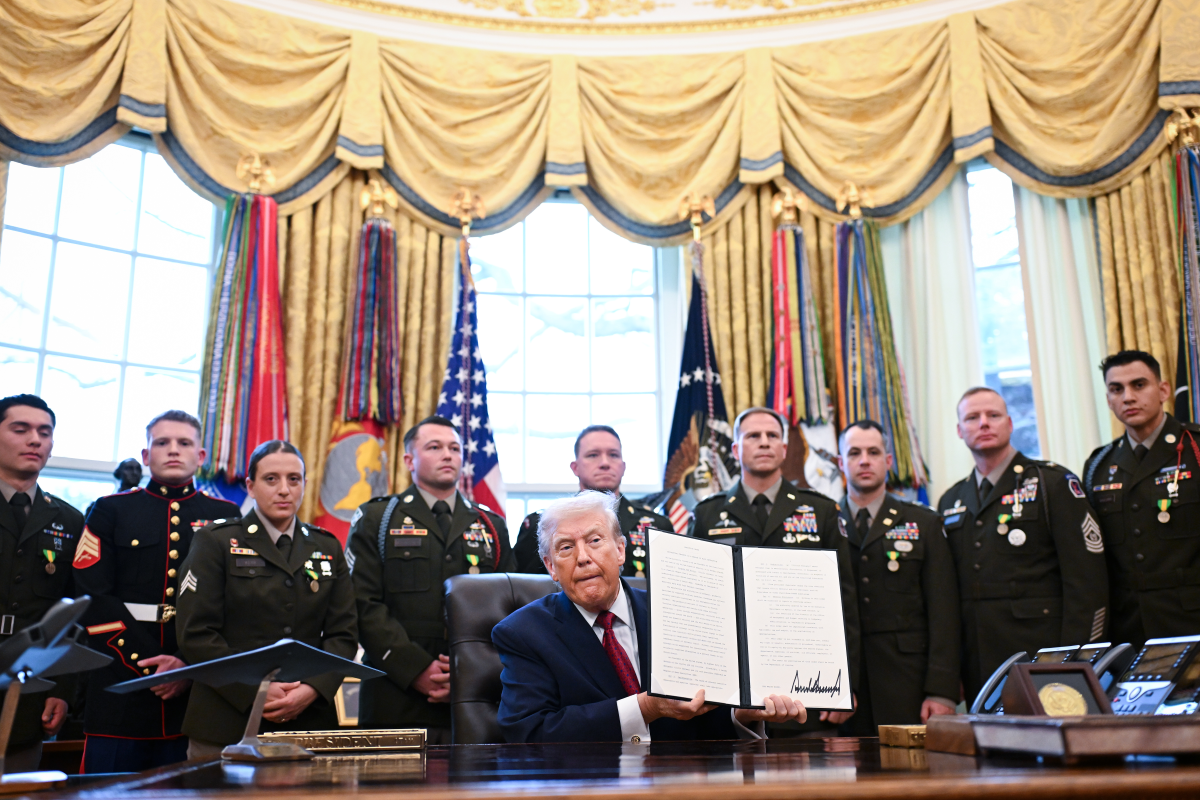
When signing the fentanyl order on Monday, Trump asked service members recently awarded the "Mexican Border Defense Medal" to join him at the Resolute Desk.
"How about gathering around me and we'll hold this up?" Trump said, displaying his 221st executive order. "... Let's take a good picture."