In the town of Chimbay within Uzbekistan's Karakalpakstan region, an experienced artisan focuses intently on constructing a wooden frame, continuing a family legacy of yurt-making that spans generations.
Nearby, a young student works with a horsehair bow on a two-stringed instrument, striving to produce melodies described as ancient as the landscape itself.
These activities represent a wider acknowledgment throughout Central Asia. During the 20th UNESCO Intergovernmental Committee session in New Delhi, the kobyz bowed instrument and the traditional yurt, submitted jointly by Uzbekistan, Kazakhstan, and Kyrgyzstan, were added to UNESCO's intangible cultural heritage registers.
UNESCO expressed concern that elements of this heritage face "serious threat due to the reduction of experienced masters."
The Kobyz: An Ancient Musical Voice
The kobyz stands as one of the earliest bowed instruments in Turkic history, with origins scholars date to between the 5th and 8th centuries CE.
Its distinctive wooden body, curved neck, and membrane made from camel skin create a resonant sound deeply connected to shamanic practices. Historically, the term "qobuz" broadly meant "musical instrument" among Turkic communities, indicating its fundamental cultural role.
In Kazakhstan, the tradition remains vibrant in areas like Kyzylorda and Mangystau, where musicians known as kyuishi have preserved the instrument's repertoire across generations.
In Kyrgyzstan, aspects of the tradition endure in regions such as Issyk-Kul and Naryn, where related bowed instruments are still used in epic storytelling performances.
Building a kobyz demands specialized knowledge—selecting appropriate wood, carving the body from a single piece, and preparing horsehair for strings and bow—skills traditionally handed down within families.
Today in Karakalpakstan, the kobyz persists primarily through zhyrau, epic narrators who accompany their tales with the instrument. However, this practice is diminishing rapidly.
Ermek Bayniyazov, a zhyrau from a village near Nukus, observes the swift decline of the craft. "When I was young, you could walk into any village and someone would know how to tune or repair a kobyz. Now I can count the real masters on one hand. If one of them stops working, the skills disappear with him."
He adds: "A kobyz isn’t like a guitar you can buy in a shop. The body must be carved from a single block. The horsehair must be washed, dried and twisted in a certain way. Even choosing the right tree used to be an art. Today there are players who don’t know how the instrument is built, and that’s a warning sign for the future."
The Yurt: Architectural Heritage of the Steppe
If the kobyz provides a sonic expression of the steppe, the yurt constitutes its architectural form. For nomadic and semi-nomadic groups like the Karakalpaks, Kazakhs, and Kyrgyz, the yurt served as the primary dwelling until the late 1800s. By the mid-20th century, its use persisted mainly among herders during seasonal movements.
Historically, the yurt carried profound social significance. A man seeking marriage was expected to possess one; among early Turkic tribes like the Karluk and Kipchak, families would not permit their daughter to marry a man without a yurt.
Wedding yurts were typically covered in white felt, while everyday versions, known as kara ui, utilized darker materials.
Throughout the region, the yurt symbolized continuity and a bond with the land. For many communities, its interior represented an ordered microcosm, with the world outside its felt walls forming a broader universe.
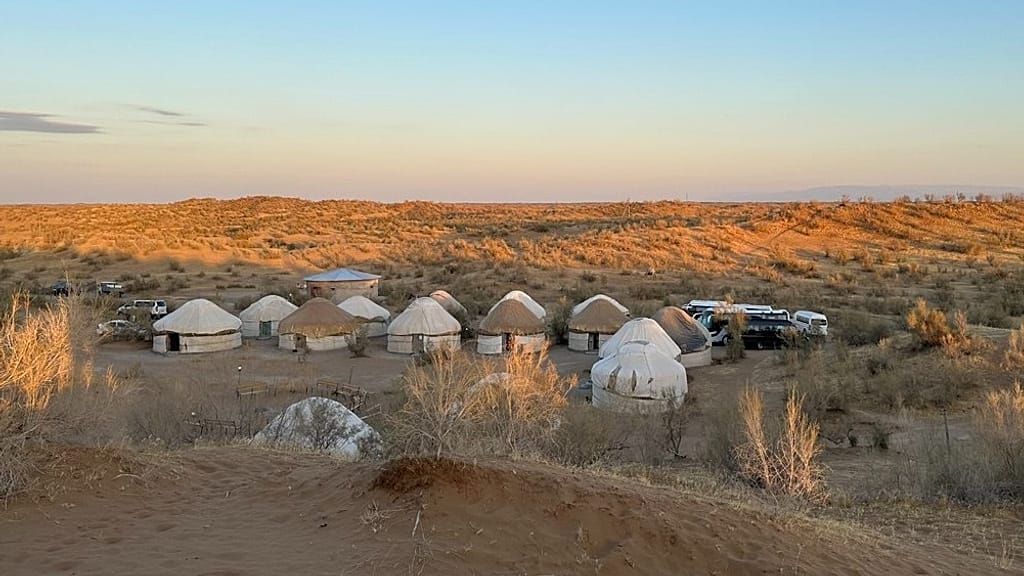
In Uzbekistan, yurts remain part of cultural practices in Karakalpakstan, Surkhandarya, Navoi, and other areas. They are still erected in summer months near water sources or trees, with felt panels adjusted to allow airflow.
Chimbay remains one of the few hubs of traditional craftsmanship, where workshops maintain yurt-building methods alongside studios producing embroidered textiles like suzani. Artisans seldom use the term "heritage," yet their expertise forms the foundation of what UNESCO seeks to protect.
Today, yurts function less as primary residences and more as cultural venues, including sites where visitors can engage directly with nomadic traditions. Vohid Pirmatov, who operates "Kyzylkum Safari" yurts in Navoi, explains that authentic felt structures provide a unique link to history.
"Our yurts are made from natural felt, the same material traditionally used in nomadic homes. The walls breathe, the air passes through, keeping the inside cool."
He notes increasing tourist interest: "We see many tourists, especially from Germany, France and Italy. They want to feel the atmosphere for themselves, not just read about it."
The Significance of UNESCO's Recognition
The inscription emphasizes both the cultural richness of these traditions and the pressing need to safeguard them.
Expert kobyz makers are growing scarce. Environmental challenges limit access to suitable timber for yurt frames. Younger generations frequently gravitate toward modern music and digital technologies rather than traditional crafts.
Gulbakhar Izentaeva, director of the Savitsky State Museum of Art in Nukus, points out that this marks the first time an element from Karakalpakstan has been inscribed on UNESCO's intangible heritage lists, and the first from Uzbekistan placed on the Urgent Safeguarding List.
She cautions that "young people do not often listen to traditional music and do not want to learn how to make the kobyz."
Izentaeva adds that knowledge preserved for centuries now relies on a small number of masters and a rapidly evolving social context.
Saida Mirziyoyeva, Head of the Presidential Administration, remarked on social media that the inscription highlights the enduring connection between generations. "This reflects the depth of our traditions, the strength of our spiritual heritage, and the continuous link between generations."
Across Central Asia, the inscription is viewed as acknowledgment of a living chain of knowledge.
Even as daily life evolves, the kobyz and the yurt continue to serve as anchors of cultural identity throughout the region, sustained by communities that still practice and transmit these traditions.