
This year, scholars worldwide have employed cutting-edge methods to solve enigmas that have puzzled historians for generations. Their discoveries are reshaping narratives about bygone eras.
Ancient Statues and Cityscapes
At historic locations, archaeological work has revealed new details. Examination of a quarry with incomplete sculptures illuminated how Polynesian travelers crafted the colossal stone heads scattered across Easter Island.
In Pompeii, a recent initiative discovered a stone stairway that may help visualize the city's appearance prior to its burial under volcanic ash in AD 79.
Additionally, by combining microbotanical study with aerial drone imagery, experts have formulated a novel theory about the creators of the perplexing "band of holes" pattern, comprising roughly 5,200 pits in the Peruvian Andes.
Preserved Cleric and Ancient Vessel
A crypt leak involving the "air-dried chaplain" aided in identifying a remarkably preserved body stored in an Austrian village church since the 1700s. With skin and tissue intact, the mummy, believed to be an 18th-century clergyman, had sparked theories about healing powers and poisoning rumors.
Repairs due to water damage allowed for CT scans, bone and tissue analysis, and radiocarbon dating, confirming the remains as Franz Xaver Sidler von Rosenegg, an aristocrat who served as a monk before becoming a vicar. Researchers identified an undocumented embalming technique and proposed a new cause of death, while solving the mystery of a glass object found within the body.
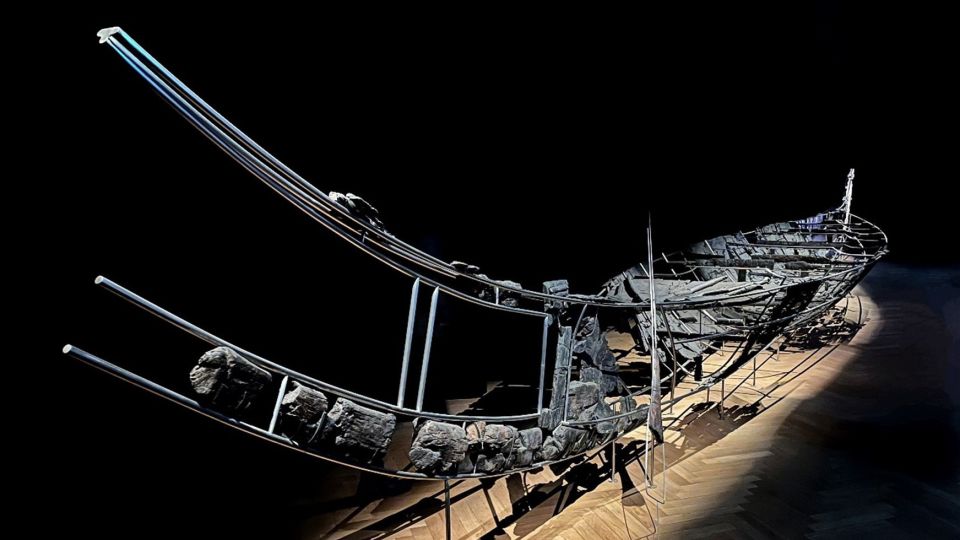
The Hjortspring boat, displayed in Copenhagen, has long been of unknown origin. Excavated from a Danish bog in the 1920s, over 2,000 years after sinking, it was filled with weapons, hinting at a warrior attack. Recent analysis of its materials indicates it traveled farther than assumed, suggesting a premeditated assault. A partial fingerprint in tar residue offers a direct connection to a crew member.
"Fingerprints are very rare for this time period and area," said lead author Mikael Fauvelle, an associate professor at Lund University, noting that "to find one on such a unique boat is extremely special."
Wolf Cubs and Military Pathogens
Over 14,000 years ago, two female pups were trapped in a collapsed den in Siberia, with mummified remains unearthed in 2011 and 2015. Preserved with fur and stomach contents, they were thought to be early dogs or tamed wolves. However, genetic and chemical analysis reveals they were wolf cubs with no human interaction, clarifying the timeline of dog domestication.
During Napoleon's 1812 invasion of Russia, his army of over 500,000 men suffered massive losses, with only tens of thousands returning after retreat. While battle, starvation, cold, and typhus were known factors, new genetic evidence points to additional causes.
"Previously, we just thought that there was one infectious disease that decimated the Napoleon army — the typhus," said lead author Rémi Barbieri, a postdoctoral researcher at the University of Tartu. His team found Salmonella enterica and Borrelia recurrentis in soldiers' teeth, bacteria that cause paratyphoid and relapsing fevers, potentially contributing to deaths.
Other Notable Findings
In 2025, scientists also addressed other intriguing questions: the mystery volcano behind a 1831 eruption that cooled Earth was identified; the potato's origin was traced to a wild tomato encounter millions of years ago; and a decoded error showed the lost Song of Wade lacked supernatural elements as once thought.