
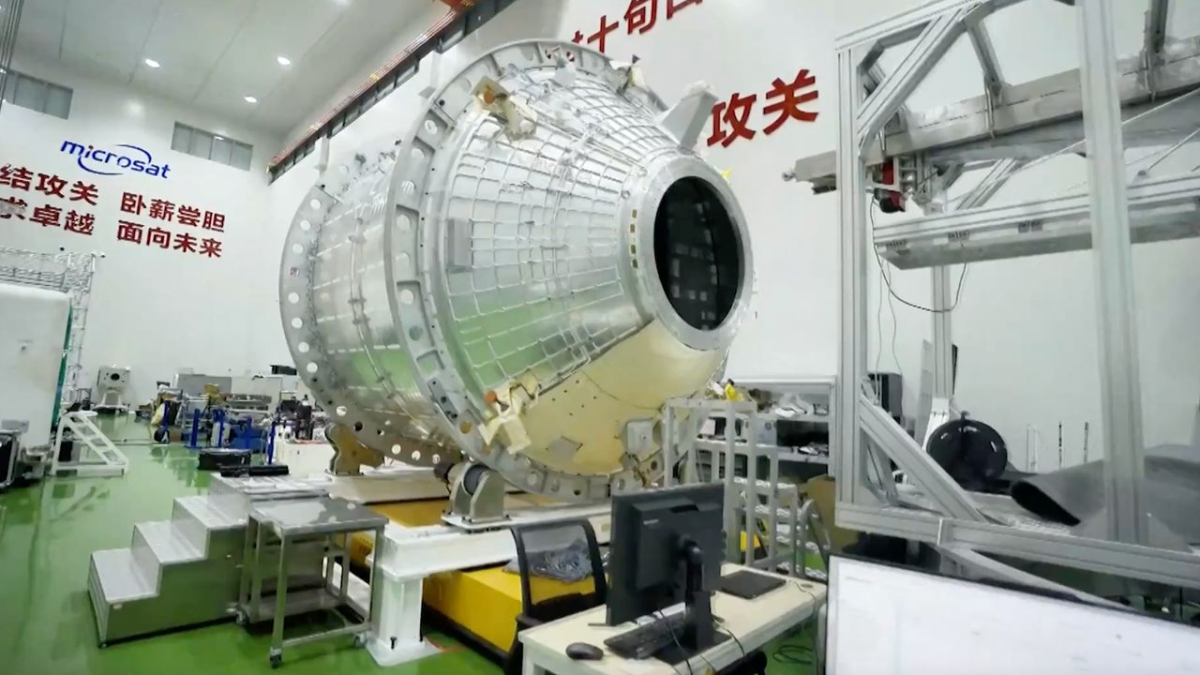
New Cargo Vehicle for Chinese Space Station
China is progressing with preparations for the inaugural mission of a novel, economical cargo spacecraft designed to service its Tiangong space station.
Developed by the Innovation Academy for Microsatellites of the Chinese Academy of Sciences, the Qingzhou, or "Light Ship," is intended as a more compact and potentially less expensive alternative to the existing Tianzhou cargo ships.
Development Status and Specifications
Following a successful design review in June, the spacecraft has moved into the early manufacturing stage. The prototype features a diameter of approximately 3.3 meters and a launch mass near 5,000 kilograms. It is designed to transport up to 1,800 kilograms of supplies to orbit.
The vehicle employs a hybrid design, incorporating a pressurized section for crew essentials and delicate equipment, along with an unpressurized rear segment suitable for external payloads and experiments requiring exposure to space.
"We have now conducted large-scale experiments and are currently loading and verifying the status of the remaining individual machines, as well as conducting final testing. The overall test results are quite good," stated Wu Huiying, deputy chief designer of the Qingzhou cargo spacecraft.
Future Timeline and Launch Plans
Manufacturing of the full engineering model is slated to commence in early 2026, with assembly expected to conclude by year's end. The first flight will be scheduled according to the operational requirements of the Tiangong station.
Initial plans for the prototype to launch aboard the maiden flight of the commercial Kinetica-2 rocket from CAS Space appear to have changed. Reports indicate preparations are ongoing for that rocket's launch from the Jiuquan spaceport in the Gobi Desert.
The Qingzhou is part of a duo of new spacecraft initiatives by China's human spaceflight agency aimed at modernizing space logistics. The companion project, named Haolong, is a reusable shuttle concept under development by a state-owned aviation research institute.