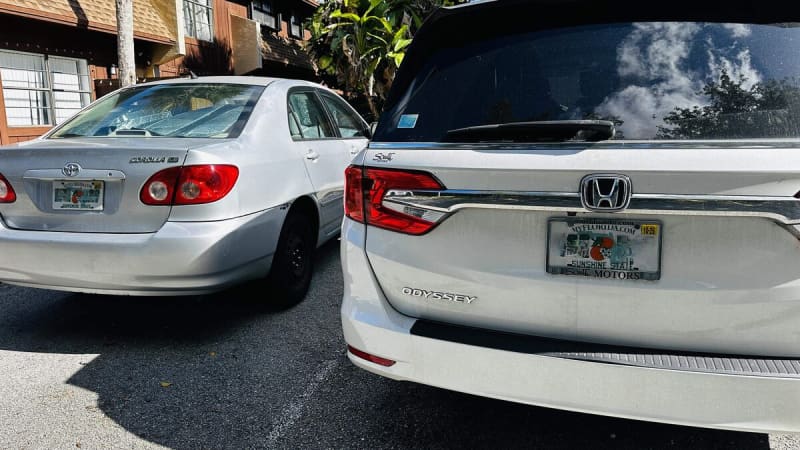
Florida motorists have expressed uncertainty regarding the legality of license plate frames since revised regulations became effective on October 1.
While the underlying statute isn't novel, the consequences for violations have been substantially enhanced.
Social media platforms have been flooded with questions from vehicle owners about whether they must eliminate dealer or sports-themed frames from their plates, accompanied by widespread misinformation circulating online.
"I was worried my license plate cover ... was going to have to be taken off," stated Ally Blake, a Florida meteorologist who covers traffic matters.
This confusion has extended to some law enforcement personnel as well.
In response, the Florida Department of Highway Safety and Motor Vehicles released a clarifying memorandum on December 12.
The fundamental guideline: Frames become unlawful only when they conceal the plate's identifying characters. Additionally prohibited are sliding mechanisms or other coverings that hide plates from automated readers at toll stations or traffic stops.
"License plate frames are not prohibited as long as they do not obstruct the alphanumeric plate number or the registration validation decal in the upper right corner," explained Miami-Dade Tax Collector Dariel Fernandez, whose department handles plate distribution.
Violators now face significantly harsher sanctions.
Understanding Florida's Frame Regulations
Frames remain permissible in Florida provided they don't obscure these critical plate elements:
• The alphanumeric identifier—your plate's combination of letters and numbers.
• The registration decal positioned in the top right corner, typically yellow and renewed annually or biannually.
• According to official guidelines, information at the plate's bottom isn't considered primary. Frames may cover this area if law enforcement can still identify the issuing state.
• Text like "MyFlorida.Com" at the top and "Sunshine State" at the bottom aren't primary information, but caution is needed since the registration sticker aligns with the top text. Obscuring the sticker remains illegal.
Prohibited Items and Devices
Miramar city officials recently highlighted banned items on social media. Avoid these on your plates:
• Tinted, smoked, or transparent plate covers.
• Frames, decals, bolts, or accessories that block letters, numbers, or decals.
• Sprays, coatings, or reflective materials applied to plates. Any device designed to obscure or interfere with plate visibility, including those marketed to evade toll readers or traffic cameras.
Illuminating devices projecting red, red and white, or blue light onto plates are also banned—attempting to mimic emergency vehicles constitutes a serious felony.
Mechanisms that flip, hide, or switch between plates are strictly prohibited, with severe consequences for manufacturers, sellers, or installers.
Enhanced Penalties and Fines
While the infractions existed previously, penalties changed in October:
• Obscuring primary plate features with frames is now a second-degree misdemeanor, upgraded from a noncriminal traffic violation.
• Fines can reach $500, replacing previous warnings or minor fines.
• Jail sentences up to 60 days are now possible.
• Selling, manufacturing, or distributing obscuring devices like plate flippers constitutes a first-degree misdemeanor, punishable by up to one year imprisonment and $1,000 fines.
• Using license-obscuring devices during criminal activities elevates offenses to third-degree felonies, carrying potential five-year prison terms and $5,000 penalties.
Practical Recommendations
For those uncertain about their frames, Doral Police Chief Edwin Lopez offered straightforward advice during a recent interview: simply remove them.
"It's quite frankly, very simple as that. It's a recommendation that I've given to my parents," he remarked. "I simply told them to remove the license plate frame from the vehicle. It's just simpler that way. Instead of getting into a back and forth as to if some items are obscured and some are blocked, and some are not."