Hubble's Breakthrough Discovery
NASA's Hubble Space Telescope has provided astronomers with an extraordinary view of cosmic events that have puzzled scientists for years. Observations have revealed that what was once believed to be planetary formations near the young star Fomalhaut were actually the aftermath of violent space collisions.
Decades of Mystery Unraveled
For many years, researchers observed a bright, dense region in the vicinity of Fomalhaut. Initial interpretations suggested this might represent a newly forming planet, leading to continued monitoring of the area. However, recent data from Hubble has dramatically changed this understanding.
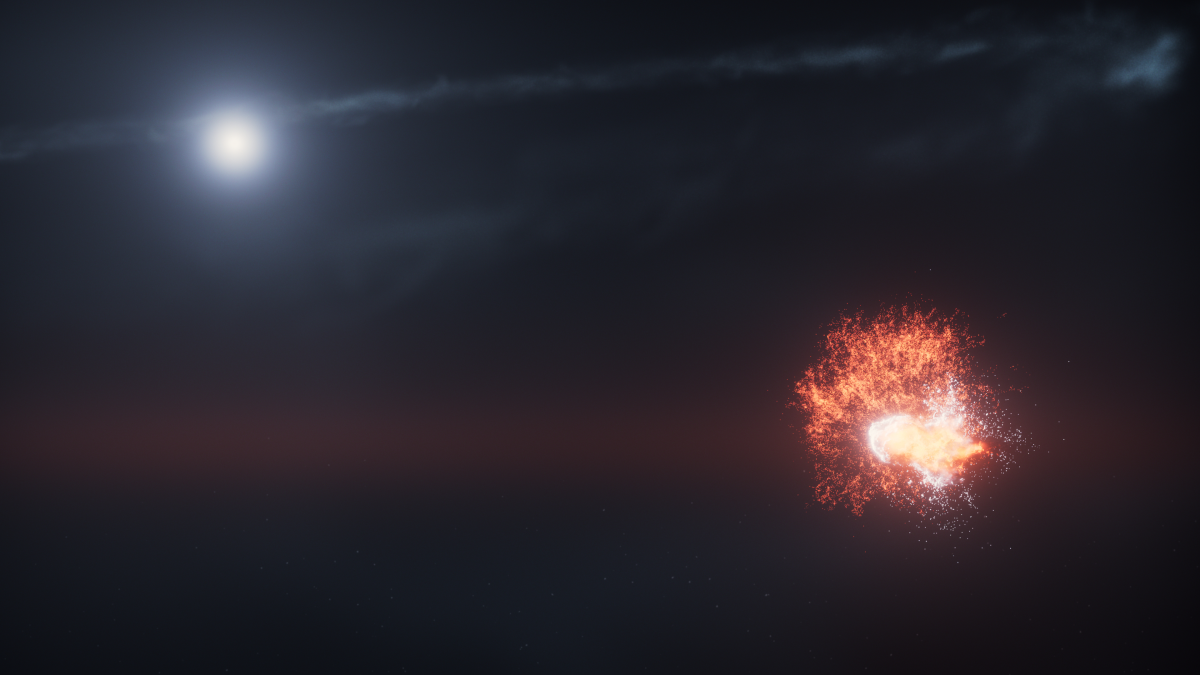
In 2023, telescope images showed the original bright spot had completely disappeared, while a new one emerged nearby. This transformation provided crucial evidence that the phenomenon was not planetary in nature but rather the result of cosmic impacts.
Rare Cosmic Events
Scientists determined they were observing the dusty remnants from two separate collisions between massive space objects. These impacts created extensive dust clouds dense enough to mimic planetary signatures when viewed from Earth. Over time, these debris fields gradually dispersed until they became undetectable.
The space rocks involved in these collisions measured at least 37 miles (60 kilometers) in diameter. Capturing such events is exceptionally rare, with theoretical models suggesting similar collisions occur in any given region only about once every 100,000 years.
"It's highly unexpected that this area has now exhibited two, unique, massive collisions inside 20 years," said Joshua Lovell of the Harvard-Smithsonian Center for Astrophysics in an email. Lovell was not involved in the research, which appeared in the journal Science.
Scientific Implications
The findings present two possibilities: either scientists made an exceptionally fortunate observation, or such cosmic collisions occur more frequently than current models predict. Additional data collection will be necessary to determine which scenario is correct.
Large-scale space collisions play fundamental roles in planetary formation and composition. Studying these events provides valuable insights into the early development of solar systems.
"Studying them is like taking a toddler picture of our solar system," said astrophysicist Meredith MacGregor of Johns Hopkins University, who was not involved with the study.
Future Observations
Researchers plan to monitor the newly discovered dust cloud in coming years to track its evolution and eventual dissipation. The star system where these collisions occurred is relatively close to Earth at just 25 light years away.
By continuing to observe this region, scientists are "catching these violent explosions in real time," said study author Paul Kalas of the University of California, Berkeley.