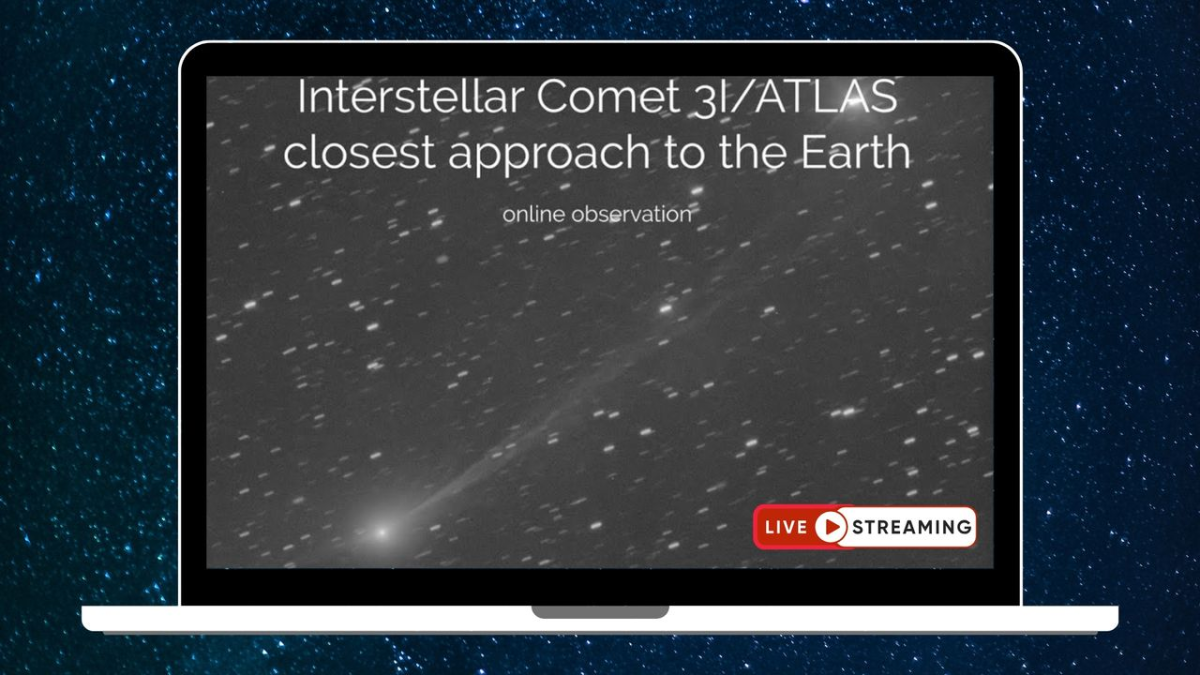

On Friday, December 19, the interstellar comet designated 3I/ATLAS made its nearest pass by our planet. Although it posed no danger to Earth, scientists precisely tracked its approach.
Timing and Distance
Data from NASA's Jet Propulsion Laboratory Horizons system indicates the comet was closest at 1 a.m. EST (0600 GMT) on December 19. At that moment, it was approximately 1.8 astronomical units away—about 168 million miles or 270 million kilometers—which is nearly double the average Earth-sun distance.
Discovery and Significance
First spotted on July 1 by ATLAS telescopes in Chile, 3I/ATLAS represents only the third known interstellar object to traverse our solar system, following 'Oumuamua in 2017 and 2I/Borisov in 2019.
While too distant to be visible without telescopes, this flyby holds substantial scientific importance due to the rarity of interstellar visitors. Observing 3I/ATLAS near its closest approach allows astronomers to analyze material that originated around another star, providing brief insights into distant planetary systems.
Public Engagement
For those interested, the Virtual Telescope Project hosted a live online broadcast from December 19 to 20 on Space.com. The stream commenced at 11 p.m. EST on December 19 (0400 GMT on December 20), giving viewers a potential real-time look at the comet's approach, weather conditions permitting.