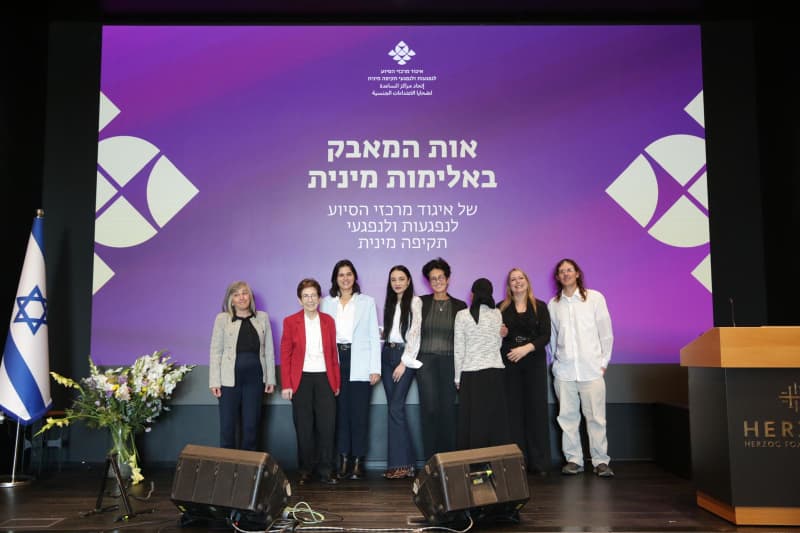
On Wednesday, the Association of Rape Crisis Centers in Israel (ARCCI) observed its 35th anniversary, recognizing both progress in public awareness about sexual violence and ongoing systemic shortcomings.
During a special event, the organization presented the Sexual Violence Prevention Award to several individuals whose efforts have promoted survivor protections, revealed injustices, and influenced changes across legal systems and social attitudes.
"There has been a profound change in awareness," stated ARCCI executive director Orit Sulitzeanu. "Not because sexual violence has disappeared – it hasn’t – but because survivors are increasingly willing to step forward, publicly, with names and faces."
Sulitzeanu, who has led ARCCI for over ten years after extensive work in feminist advocacy, noted that the most notable transformation she has seen relates to how discussions about sexual violence are framed.
"For years, the focus was on victims," she explained. "Today, the language is about survivors."
Ongoing Legal and Cultural Battles
This linguistic shift, according to Sulitzeanu, is connected to continuing legal and cultural conflicts, especially concerning accountability and justice access.
These tensions were recently highlighted when a new sexual assault complaint was filed against Israeli pop singer Eyal Golan, distinct from the earlier widely publicized case involving Taisia Zamolowski and other women who were minors at the time.
The recent complaint involves a woman who alleges that approximately ten years ago, during a facial treatment at her clinic, Golan exposed himself without consent and later pressured her to send nude photographs.
This complaint was submitted months ago and is currently under police investigation, including an assessment of whether the statute of limitations applies. Golan has denied the accusations, claiming they are part of an extortion attempt and that he has messages and recordings that contradict them.
The issue of limitations is crucial not only for this complaint but for Israel's broader confrontation with sexual violence.
Among this year's award recipients were Zamolowski and "N," two women whose accounts brought renewed attention to what has been termed "the social games affair."
This case refers to the 2013-2014 investigation into allegations that teenage girls were sexually exploited by influential men in the entertainment industry, including Golan, through intermediaries who arranged paid sexual encounters.
While Golan was not indicted due to evidentiary challenges, the case left a lasting public impact after his father, Danny Biton, was convicted of offenses related to prostitution involving minors.
The affair resurfaced prominently in 2022 when Zamolowski and N gave televised interviews detailing their experiences, the power dynamics involved, and the long-term harm they say they endured.
Their testimonies helped spark Israel's #MeToo-era discussions about celebrity, silence, and accountability, even without criminal convictions against the main public figure.
At Wednesday's ceremony, Zamolowski said, "I am not just fighting against him, but against the fan base and public that defends him. I knew the price of going public, but I also know that secrets don’t stay in the dark."
N stated, "I believe this fight is beyond personal. I am here not only as someone who was violated, but as someone who chose to use that experience as a tool for change."
"When we filed the complaint," she added, "I knew we were going up against an ancient power system designed to quiet us. But our fight was about truth, justice, and a society that refuses to turn a blind eye."
Sulitzeanu remarked that seeing the two women on stage symbolized the change she has observed over time. "When the investigation began, I didn’t know them personally," she said. "Today, you see them on stage – coherent, intelligent, strong. That’s the change."
Legislative Progress for Survivors
Despite the disruptions caused by Hamas's October 7 massacre and the subsequent war, Sulitzeanu noted that ARCCI has continued collaborating with legislators, supporting or advancing ten legislative initiatives designed to enhance survivors' rights.
One key achievement was a recent amendment to the Legal Aid Law, passed by the Knesset, which enables survivors of sexual assault and violence to receive free, government-funded legal representation starting from when they file a police complaint. Previously, such aid was typically available only at later stages of criminal proceedings.
Under this reform, survivors can now have an attorney accompany them during the investigation phase, regardless of income—a step the Justice Ministry said improves justice access and the handling of sexual violence complaints.
Nevertheless, Sulitzeanu emphasized that the legal framework remains inadequate.
Current Israeli law imposes statutes of limitations on most sexual offenses, with time limits varying by offense severity and victim's age. For cases involving minors, the clock starts only when the survivor reaches adulthood, but limitations still apply.
In recent years, survivor organizations, the Justice Ministry, and Knesset members have advocated for completely abolishing statutes of limitations for sexual offenses, contending that trauma, fear, and power imbalances often delay reporting for years or decades.
In June, a Knesset committee moved forward with legislation that would eliminate or substantially extend limitation periods for sexual crimes against minors, representing a significant policy shift documented in official Knesset records. However, the bill has not yet completed the legislative process, and no final law has been passed.
"Any gain is good," Sulitzeanu commented. "Even extending limitations matters. But the fight is far from over. We will continue it wherever we can."