
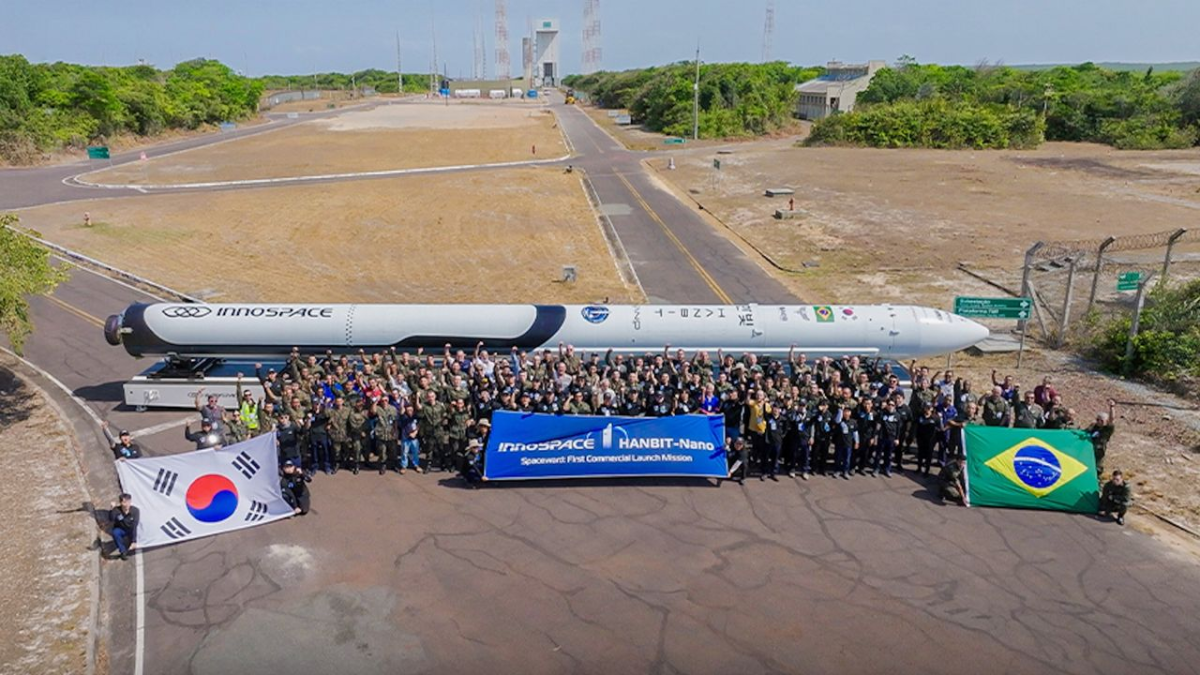
Today marks a significant milestone for South Korea's private space sector as startup Innospace prepares for its inaugural orbital launch attempt.
Launch Details and Mission Objectives
The scheduled liftoff is set for 3:00 p.m. EST (2000 GMT) from Brazil's Alcantara Space Center. The company's Hanbit-Nano rocket will deploy five small satellites into a 300-kilometer orbit for clients from Brazil and India.
"Hanbit-Nano has been successfully rolled out from the integration facility and transported to the launch pad ahead of liftoff. Preparations for the Spaceward mission are right on track," Innospace stated on Wednesday (Dec. 16) in a social media post.
Technical Specifications and Company Background
The 17.3-meter tall vehicle is engineered to deliver payloads of up to 90 kilograms to sun-synchronous orbit from the Brazilian launch site. Its propulsion system features a first-stage hybrid engine using paraffin and liquid oxygen, with upper stage options including methane and liquid oxygen or paraffin and liquid oxygen configurations.
Innospace CEO Kim Soo-jong revealed during an October interview that the company was founded in 2017 and currently employs 260 staff members.
"All of our technology is developed by ourselves. The engineers are Korean, and the development is fully indigenous," Kim emphasized. "Korea has built an ecosystem to develop a launch vehicle. We work with more than 100 supply-chain companies in South Korea."
Market Focus and Future Plans
The company has established a strong international presence, with Kim noting, "We already have around 14 contracts with global satellite companies."
This initial launch carries substantial importance for the company's roadmap. According to Kim, if successful, the more advanced Hanbit-Micro model capable of carrying 170 kilograms to orbit is planned to commence commercial operations early next year.
The launch was originally planned for Wednesday (Dec. 17) but was postponed by two days to allow for replacement of a component in the rocket's first-stage cooling system.
Live coverage of the event begins at 2:00 p.m. EST (1900 GMT), available through various streaming platforms.