Exploring the Ocean's Twilight Depths
Beneath the waves off Guam's coast, over 300 feet down, sunlight barely reaches. This region, called the upper twilight zone, remains one of Earth's most mysterious habitats due to its extreme depth and inaccessibility.
In November, a team of scientific divers from the California Academy of Sciences undertook a series of challenging dives to this remote area. Their objective was to recover monitoring equipment that had been gathering data on marine ecosystems and water temperatures for more than eight years.
Perilous Diving Conditions
Reaching these depths requires specialized techniques and equipment. Standard diving gear is insufficient beyond 130 feet, so technical divers use mixtures of helium and air to breathe safely. The pressure at such depths causes gases to dissolve into the body, necessitating extremely slow ascents to prevent decompression sickness.
"If we stay just 10 minutes at 500 feet, it would take us six hours to go up," explained Luiz Rocha, an ichthyology curator at the California Academy of Sciences and one of the divers. This limits their working time to about 30 minutes per dive.
Retrieving the Data Collectors
During eight dives in November, the team successfully collected 13 monitoring devices. These structures, made of PVC plates, serve as artificial reefs where marine organisms settle and grow. Rocha described them as "essentially small underwater hotels that coral reef organisms colonize over time."
The retrieved monitors, covered in vibrant colors from marine life, were transported to the University of Guam Marine Laboratory for analysis. Scientists carefully examined the encrusted materials, identifying, photographing, and collecting each specimen while sending remaining material for DNA testing.
Discoveries and Concerns
Initial processing revealed approximately 2,000 specimens, including 100 previously unrecorded in the region and 20 potentially new species. Findings included a possible new cardinalfish species, an orange-clawed crab not previously seen in Guam, and a colorful sea slug.
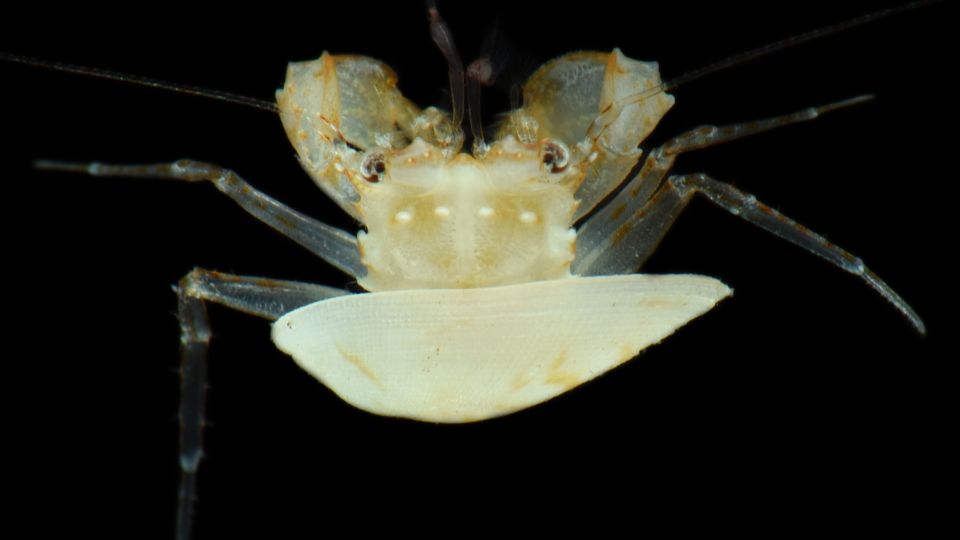
Rocha was particularly fascinated by a hermit crab using clam-like shells instead of the typical snail shells. "Every hermit crab I've seen before used gastropod (snail-like) shells as homes, but this species has some really interesting adaptations that allow it to use clams instead," he noted.
However, the expedition also revealed troubling signs. More than half of the species in these deep reefs remain unknown, "yet these reefs are already being affected by fishing, pollution, and climate change," Rocha stated. Plastic debris, primarily from fishing activities, increases with depth, peaking in the twilight zone. "We are almost always the first humans to set eyes on these deeper reefs, and yet we see human-produced trash on every dive," he added.
Temperature data from the monitors suggests warming trends even at these depths, challenging assumptions that deeper waters might serve as climate refuges. "This contradicts assumptions that this depth would be a safe refuge, protected from warming," Rocha said.
Future Research
The November mission initiates a two-year project to collect 76 monitoring devices from deep reefs across the Pacific, including locations in Palau, French Polynesia, and the Marshall Islands. Researchers aim to gain comprehensive insights into twilight zone ecosystems and develop strategies for their protection.